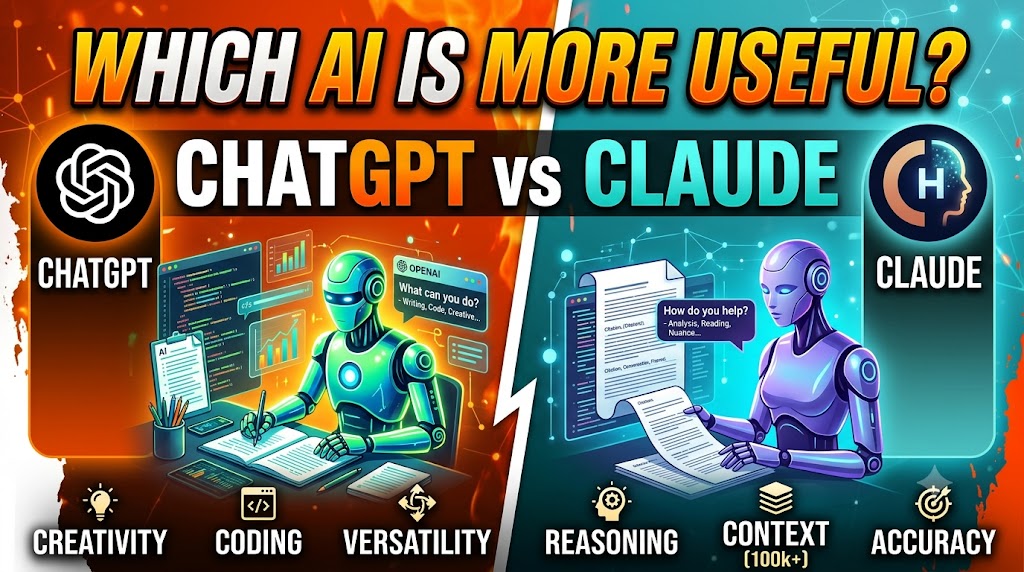
ChatGPT vs Claude
ChatGPT is a general-purpose AI assistant from OpenAI that can handle a wide range of tasks, including answering questions, writing and rewriting, coding, research, file analysis, data analysis, image understanding and generation, web search, and deep research. Its current toolset also includes specialized experiences for longer work and coding, depending on the user’s plan and availability. This makes ChatGPT particularly useful for users who want one AI platform that can cover many different types of everyday, creative, technical, and research-oriented work. (OpenAI Help Center)
Claude is Anthropic’s AI assistant, with a strong focus on reasoning, writing, coding, long-context work, and professional knowledge tasks. Anthropic’s current Claude family includes models designed for complex coding and agentic workflows, while Claude can also work with documents and other professional tasks. Anthropic says its latest models support long-context reasoning and advanced coding, and its Claude Code product is designed for more autonomous software-development workflows. (Anthropic)
Quick Comparison
| Feature | ChatGPT | Claude |
|---|---|---|
| General AI Assistance | 🏆 Better | Excellent |
| Writing & Content Creation | 🏆 Better | Excellent |
| Coding | 🏆 | 🏆 |
| Research & Analysis | 🏆 Better | Excellent |
| Long Documents & Context | Excellent | 🏆 Better |
| File Analysis | 🏆 Better | Excellent |
| Data Analysis | 🏆 Better | Excellent |
| Image Generation | 🏆 Better | Limited |
| Image Understanding | 🏆 | 🏆 |
| Deep Research | 🏆 Better | Very Good |
| Agentic Work | 🏆 | 🏆 |
| Creative Brainstorming | 🏆 | 🏆 |
| General Users | 🏆 Better | Excellent |
| Professional Knowledge Work | Excellent | 🏆 Better |
| Overall | 🏆 Winner | Excellent Alternative |
Note: AI models, features, plans, usage limits, and availability can change over time. The comparison below focuses on the capabilities and practical use cases that are relevant to users.
1. General AI Assistance
| ChatGPT | Claude |
|---|---|
| Broad general-purpose AI assistant | Broad general-purpose AI assistant |
| Useful for writing, learning, coding and research | Strong for writing, reasoning, coding and knowledge work |
| Offers web search and multiple tools | Strong long-context and reasoning capabilities |
| Supports many different workflows | Particularly strong for complex professional tasks |
ChatGPT is designed to handle a very broad range of everyday and professional tasks, including writing, coding, research, file analysis, image work, and data analysis. (OpenAI Help Center)
Claude is also a general-purpose assistant, but Anthropic places particular emphasis on reasoning, coding, long-context work, and professional knowledge tasks. Its current models are designed to handle complex, multi-step work. (Anthropic)
🏆 Winner: ChatGPT
For the widest range of general-purpose tasks in one platform, ChatGPT has the edge.
2. Writing & Content Creation
| ChatGPT | Claude |
|---|---|
| Strong article and content writing | Strong long-form writing |
| Good rewriting and summarization | Strong instruction following and structured writing |
| Useful for brainstorming | Excellent for polished prose |
| Can combine writing with web research and other tools | Strong for professional documents |
ChatGPT supports drafting, rewriting, summarization and creative suggestions as core capabilities. It can also combine writing with web search, file analysis and other tools depending on the task. (OpenAI Help Center)
Claude has historically been particularly strong in long-form writing, instruction following, and professional prose. Anthropic’s current models continue to emphasize knowledge work, reasoning and document-oriented tasks. (Anthropic)
🏆 Winner: ChatGPT
For users who want writing plus research, analysis and additional AI tools in the same workflow, ChatGPT gets the overall edge. Claude remains an excellent choice for polished long-form writing.
3. Coding
| ChatGPT | Claude |
|---|---|
| Strong coding and debugging | Strong coding and debugging |
| Codex provides dedicated coding workflows | Claude Code provides dedicated coding workflows |
| Can run and review technical tasks in supported experiences | Strong agentic coding capabilities |
| Useful for learning and explaining code | Strong for large and complex coding projects |
ChatGPT includes Codex for coding workflows, where users can write or debug code, run tests and commands, review changes, and work with repositories. (OpenAI Help Center)
Claude has a particularly strong coding ecosystem through Claude Code. Anthropic’s research reports extensive real-world use of Claude Code for agentic coding, while its latest models emphasize coding, tool use, and long-running technical tasks. (Anthropic)
🏆 Winner: Tie
Both are excellent for coding. ChatGPT has a strong dedicated coding workflow through Codex, while Claude has a strong advantage in agentic coding and long-running software-development tasks.
4. Research & Analysis
| ChatGPT | Claude |
|---|---|
| Web Search | Strong research capabilities |
| Deep Research | Strong document and knowledge analysis |
| Can synthesize information from multiple sources | Strong long-context reasoning |
| Can produce cited research reports | Strong professional research workflows |
ChatGPT provides web search for current information and Deep Research for multi-step research that synthesizes information from multiple online sources. (OpenAI Help Center)
Claude is also strong for research and professional analysis, particularly where large amounts of information, documents, or complex reasoning are involved. Anthropic’s current products include dedicated scientific and professional research workflows. (Anthropic)
🏆 Winner: ChatGPT
For general web-based research where current sources and cited results matter, ChatGPT has the stronger overall workflow.
5. Long Documents & Context
| ChatGPT | Claude |
|---|---|
| Handles large files and documents | Very strong long-context capability |
| Useful for document analysis | Designed for very large context workloads |
| Strong file-based workflows | Particularly strong for large codebases and long documents |
Claude has made long-context processing one of its major strengths. Anthropic’s current Opus and Sonnet models support very large context windows, including 1M-token context availability for certain models and uses. (Anthropic)
ChatGPT also supports document uploads and analysis, but Claude’s very large context capability gives it a meaningful advantage for certain extremely long-document and large-codebase workflows. (OpenAI Help Center)
🏆 Winner: Claude
For very large documents, long conversations, and large codebases where context capacity is critical, Claude has the advantage.
6. File Analysis
| ChatGPT | Claude |
|---|---|
| Supports PDF and document uploads | Strong document and PDF workflows |
| Can analyze spreadsheets and structured data | Strong document analysis |
| Can create charts from data | Strong professional document workflows |
| Broad file-analysis tools | Strong long-context processing |
ChatGPT supports file uploads and can analyze documents, spreadsheets, PDFs, and other supported files. It can also perform data analysis and visualization. (OpenAI Help Center)
Claude is also designed for document-heavy work and can handle large amounts of information, with Anthropic highlighting document, spreadsheet, presentation, and professional knowledge workflows. (Anthropic)
🏆 Winner: ChatGPT
For a wider variety of file-analysis and data-analysis tasks, ChatGPT has the edge.
7. Data Analysis
| ChatGPT | Claude |
|---|---|
| Strong spreadsheet and structured-data analysis | Strong analytical reasoning |
| Can run code for analysis | Strong data and document reasoning |
| Can create visualizations | Strong professional analysis |
| Useful for CSV and spreadsheet workflows | Strong for complex analytical tasks |
ChatGPT can run code in a secure environment to analyze spreadsheets, CSV files, and other structured data and can create visualizations from that information. (OpenAI Help Center)
Claude can also perform complex analysis and work with spreadsheets and professional data. Anthropic specifically highlights financial analysis and other knowledge-work tasks for its advanced models. (Anthropic)
🏆 Winner: ChatGPT
For users who regularly need calculations, spreadsheet analysis, charts, and data-driven workflows, ChatGPT is the more complete option.
8. Image Understanding
| ChatGPT | Claude |
|---|---|
| Can analyze images, diagrams and charts | Can analyze visual information |
| Supports screenshots and uploaded images | Strong document vision capabilities |
| Can combine visual analysis with other tools | Strong for charts, tables and documents |
ChatGPT can analyze uploaded images, diagrams, screenshots, and charts. (OpenAI Help Center)
Claude’s newer models also support vision and can interpret diagrams, charts, tables, and visual content inside documents. (Anthropic)
🏆 Winner: Tie
Both are strong for image understanding. The better choice depends on the specific visual task and the model available.
9. Image Generation
| ChatGPT | Claude |
|---|---|
| Built-in image generation | No comparable native image-generation focus |
| Image editing available | Primarily focused on text, reasoning and professional work |
| Strong creative visual workflows | Can work with visual inputs |
ChatGPT supports image generation and image editing as part of its broader multimodal capabilities. OpenAI’s current ChatGPT Images 2.0 is available across ChatGPT plans. (OpenAI Help Center)
Claude’s product focus is primarily on reasoning, coding, documents, and professional knowledge work rather than native image generation. (Anthropic)
🏆 Winner: ChatGPT
If you want an AI assistant that can both understand images and generate them, ChatGPT is the clear choice.
10. Agentic Work
| ChatGPT | Claude |
|---|---|
| Work can research, analyze and create deliverables | Strong autonomous agent workflows |
| Codex can work with repositories and run commands | Claude Code can perform complex coding tasks |
| Can work across connected apps and files in supported experiences | Strong long-running agentic capabilities |
ChatGPT Work can research topics, analyze information, work across connected apps and files, and create documents, spreadsheets, presentations, reports and Sites. Codex provides a separate coding-focused agent workflow. (OpenAI Help Center)
Claude’s latest models are heavily focused on agentic workflows. Anthropic says Sonnet 5 can plan, use tools such as browsers and terminals, and operate autonomously on complex tasks. (Anthropic)
🏆 Winner: Tie
Both platforms are moving strongly toward agentic AI. Claude has a particularly strong reputation for long-running coding agents, while ChatGPT offers a broader set of agentic experiences across research, productivity and coding.
11. Creative Brainstorming
| ChatGPT | Claude |
|---|---|
| Strong brainstorming and idea generation | Strong brainstorming and writing |
| Can combine ideas with image generation | Strong at nuanced text and concepts |
| Useful for scripts and content | Strong for long-form creative work |
ChatGPT supports creative suggestions, story ideas, brainstorming and problem-solving as core capabilities. (OpenAI Help Center)
Claude is also highly capable for creative writing and nuanced idea development, particularly where long-form text and detailed instructions are involved. (Anthropic)
🏆 Winner: ChatGPT
For users who want brainstorming combined with research, visual generation, analysis, and other tools, ChatGPT is more versatile.
12. Professional Knowledge Work
| ChatGPT | Claude |
|---|---|
| Strong general professional assistant | Strong professional knowledge-work focus |
| Research, analysis, writing and data tools | Strong document, analysis and agent workflows |
| Broad tool ecosystem | Strong long-running professional tasks |
ChatGPT supports research, data analysis, document creation, coding and other professional workflows through its various tools and modes. (OpenAI Help Center)
Anthropic has increasingly positioned Claude around professional knowledge work. Its latest models are designed for research, analysis, documents, spreadsheets, presentations, coding and long-running tasks. (Anthropic)
🏆 Winner: Claude
For complex professional work involving long documents, coding, analysis and extended workflows, Claude has a slight advantage.
13. General Users
| ChatGPT | Claude |
|---|---|
| Very broad range of everyday tasks | Broad range of everyday tasks |
| Strong image, research and data tools | Strong writing, reasoning and document work |
| Voice, images and multiple tools | Strong text and professional workflows |
| Large ecosystem of capabilities | Simpler focused experience |
ChatGPT can be used for everyday tasks such as brainstorming, writing, studying, planning, math, coding, and analyzing images and files. (OpenAI Help Center)
Claude is also suitable for everyday writing, reasoning, analysis, coding and document tasks, but its strongest differentiation is in professional and complex knowledge work. (Anthropic)
🏆 Winner: ChatGPT
For the average user who wants one AI assistant for many different tasks, ChatGPT is more versatile.
14. Pricing & Plans
Pricing and available features change over time, so comparing only subscription prices can be misleading.
ChatGPT offers multiple plans and access levels, with features and usage limits depending on the plan. (OpenAI Help Center)
Claude also offers different access levels and model options. Anthropic’s current model lineup includes different performance and pricing tiers, with Sonnet 5 currently listed at $2 per million input tokens and $10 per million output tokens for API usage. (Anthropic)
🏆 Winner: Depends on Your Needs
The better value depends on whether you prioritize ChatGPT’s broader tool ecosystem or Claude’s strengths in reasoning, long-context work, and coding.
🏆 Final Comparison Table
| Category | Winner |
|---|---|
| General AI Assistance | 🏆 ChatGPT |
| Writing & Content Creation | 🏆 ChatGPT |
| Coding | Tie |
| Research & Analysis | 🏆 ChatGPT |
| Long Documents & Context | 🏆 Claude |
| File Analysis | 🏆 ChatGPT |
| Data Analysis | 🏆 ChatGPT |
| Image Understanding | Tie |
| Image Generation | 🏆 ChatGPT |
| Agentic Work | Tie |
| Creative Brainstorming | 🏆 ChatGPT |
| Professional Knowledge Work | 🏆 Claude |
| General Users | 🏆 ChatGPT |
| Pricing & Plans | Depends on Your Needs |
| Overall | 🏆 ChatGPT |
⚖️ Final Verdict
🏆 Overall Winner: ChatGPT
ChatGPT is the more useful AI for most users overall.
Its biggest advantage is versatility. It combines general conversation, writing, coding, web search, deep research, file analysis, data analysis, image understanding, image generation, and additional specialized workflows in one platform. (OpenAI Help Center)
However, Claude can be the better choice for specific professional workloads. Its strongest areas include long-context reasoning, large documents, coding, agentic workflows, and complex knowledge work. Anthropic’s latest models are specifically designed to handle long-running coding and professional tasks. (Anthropic)
Choose ChatGPT If:
- You want one AI for many different types of tasks.
- You need web search and deep research.
- You regularly analyze files and spreadsheets.
- You want built-in image generation.
- You need coding plus general productivity tools.
- You want a versatile AI for everyday use.
- You want research, writing, data and visual tools in one ecosystem.
Choose Claude If:
- Your work involves very long documents or large codebases.
- You prioritize long-context reasoning.
- You are heavily focused on coding and agentic development.
- You work on complex professional knowledge tasks.
- You prefer Claude’s style for long-form writing and reasoning.
🏆 Our Winner: ChatGPT
Overall Winner: ChatGPT
For the majority of users, ChatGPT offers the broader and more versatile package. But if your main priority is large-context work, complex coding, or long-running professional tasks, Claude deserves serious consideration and may be the better tool for your particular workflow.
⚠️ Disclaimer
The information in this comparison is based on current official product information and documentation available at the time of writing. AI models, features, pricing, plans, usage limits, tools, and availability can change over time. Features may also vary by country, account type, subscription, and platform. Always check the official OpenAI and Anthropic websites for the latest information before purchasing or subscribing to any AI service. This article is intended for general information and comparison purposes only.